
- October 1, 2026
- Posted by: admin
- Category: MCS News
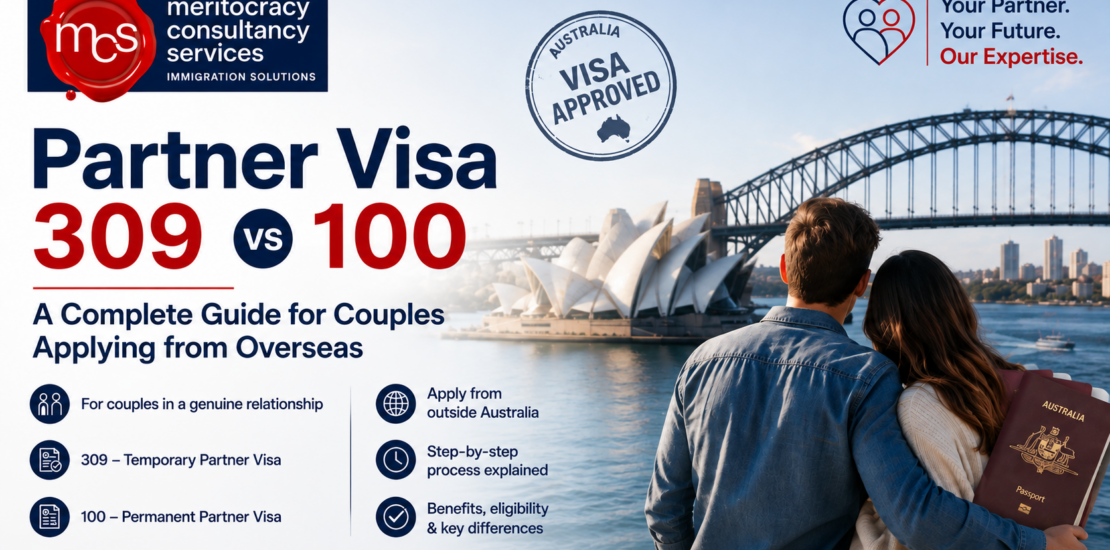
Relocating to Australia to live with your spouse entails more than just preparing for your impending life together. If one is residing outside of Australia, there are other requirements, such as obtaining an appropriate visa. Couples also prefer to visit migration agents in Sydney to know about the visa process and make an application. The partner visa options provide eligible partners of Australian citizens, permanent residents, and eligible New Zealand citizens with the opportunity to be together in Australia. The partner visa process generally consists of two parts: the partner (provisional) visa subclass 309 and the partner (migrant) visa subclass 100. If couples understand how they work, it will help them in preparing their application correctly.
What Is Partner Visa 309?
Subclass 309 Partner Visa is an intermediate visa available to recognised partners who apply from outside Australia. The holder of this visa can stay, work, and study in Australia while being eligible for the permanent visa process. Normally, applicants must stay outside Australia when they submit their subclass 309 application and also at the time when the department processes their application. This visa is ideal for couples willing to settle in Australia while their application for the permanent partner visa is in progress. In order for the visa applicants to become eligible for the application, it is necessary to prove that the relationship actually exists. The relationship can be that of a de facto partnership or of a marriage. Evidence possible to provide can be different.
What Is Partner Visa 100?
The subclass 100 partner visa is the permanent phase of the offshore partner visa process. It gives permanent residency status to applicants meeting the criteria for this visa subclass. Normally, the subclass 100 application is processed after the applicant receives the temporary subclass 309 visa. In fact, the Department of Home Affairs usually processes the application approximately two years from the date of the submission of the original partner visa request. Nonetheless, varying conditions may affect the application process. Thus, applicants need to understand the requirements for the subclass 100 partner visa that apply to their situation.
Key Differences in Partner Visa 309 vs 100
The key distinction between these two visas lies in their purpose. The 309 Visa is a temporary visa that allows an eligible overseas partner of an Australian citizen to enter and live in Australia while the partner progresses towards being granted permanent residency. Meanwhile, the 100 Visa is a permanent visa that provides permanent residency once the applicant satisfies the criteria for that visa. If you and your partner require assistance to explain these stages, contact our migration agents in Sydney to discuss your situation. These two visas also occur at various stages, with the 309 visa being the beginning of the visa application process and the 100 visas occurring afterwards. Understanding these differences helps partners to prepare their paperwork, finances, and relocation accordingly.
What Evidence Do Couples Need?
The evidence of the relationship is a significant factor in obtaining a partner visa. All the applicants must submit the evidence confirming the genuine nature of their relationship. Many forms of evidence can be presented. This proof may include documents that confirm the fact of cohabitation. Evidence of social nature can be presented as well. Such proof may include photos, travel records, and declarations of friends and relatives. The documents related to the communication may be used for the purpose of proving the relationship between partners living apart. Speaking about the evidence required for getting a partner visa, the most essential thing is that the evidence must be presented in accordance with the requirements and the nature of relationship as every relationship is unique. If you are unsure, our migration agents who are expert in partner visa process can assist you with the whole process.
Should You Use a Migration Professional?
Making an application for a partner visa can entail a complex set of requirements or lots of supporting documentation. Some couples decide to use the counsel of a professional. Partner visa migration agent Sydney can be of help to applicants in numerous ways. They will help with many aspects of the application, signalling what documents need to be submitted, what gaps in documents exist before submitting, and assisting in the form filling. Other areas where partner visa agent Sydney assist their clients include filling in documents and dealing with the Australian Department of Home Affairs.
Common Mistakes to Avoid
Most couples make the mistake of providing weak proof of their relationship. Evidence needs to be close to that which represents the actual situation, and it should be real. Other common mistakes include discrepancies in the documentation provided. Names, addresses, travel dates, and relationship history need to be consistent across all paperwork. Also, applicants must avoid submitting documents that contain significant information at the last moment.
For example, police checks, identity documents, medical tests, and certificates take time to be obtained. If the above-mentioned tips are sufficient to avoid many mistakes, still one should seek professional help. A partner visa migration agent Sydney, for example, can prepare application for the partner visa and let you review before submission and explain the further steps including ongoing need of submitting supporting documents to strengthen your partner visa application. If one needs legal assistance, a partner visa agent Sydney can clarify important details about the procedures of partner visas.
Conclusion
The two parts of the offshore Partner Visa process are subclass 309 and subclass 100. Subclass 309 is the provisional visa, while subclass 100 is a permanent visa. Couples applying for the Partner Visa need to familiarise themselves with eligibility requirements and prepare appropriate evidence of relationship. Each visa application has its own individual situation, and having the right information can enable applicants to prepare their case in advance.